NPCI’s New UPI Gift Card Rules: What India’sFintech Ecosystem Must Prepare For Before May 31
NPCI introduces new MCC 7016 for UPI gift card transactions, separating them from wallet top-ups. Know the new ₹10,000 transaction cap, compliance deadline, and what it means for India’s fintech ecosystem.
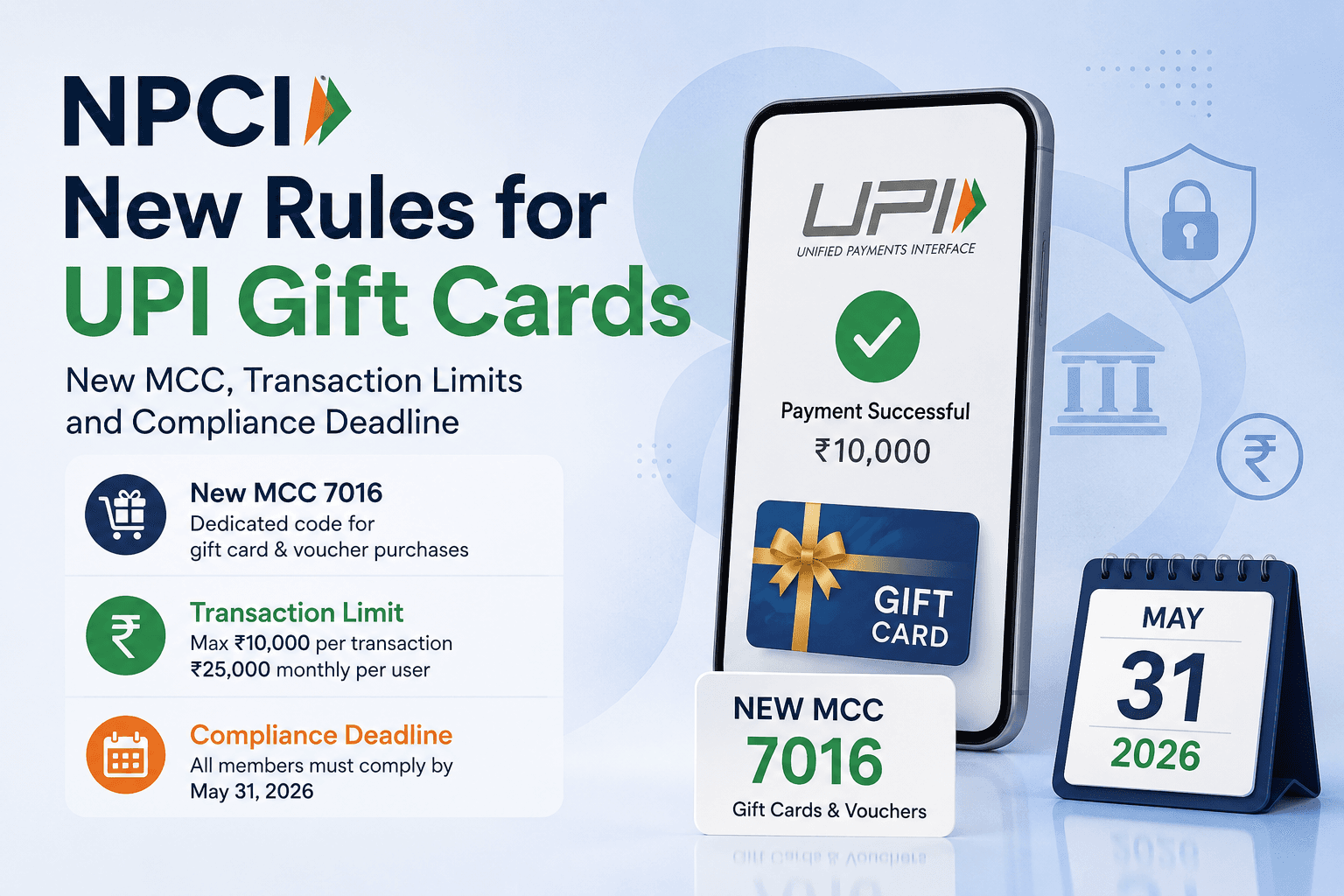
The National Payments Corporation of India (NPCI) has now introduced a dedicated Merchant Category Code (MCC) for UPI-based gift card and voucher purchases, separating them from prepaid wallet top-ups for the first time.
Until now, gift card transactions were routed under MCC 6540 — the same category used for loading prepaid wallets. That overlap made it difficult for banks, payment service providers, and regulators to clearly identify whether a transaction was a wallet funding activity or a gift voucher purchase.
Now, NPCI wants that distinction to be crystal clear.
What Exactly Has Changed?
NPCI has directed all UPI member banks, acquiring banks, and payment service providers to migrate gift card and voucher merchants to a brand-new MCC 7016 by May 31, 2026.
This means:
- Gift card purchases will now have a separate transaction identity
- Wallet top-ups and voucher purchases will no longer sit under the same reporting bucket
- Payment processors must reclassify existing merchants before the compliance deadline
The move may look technical on the surface, but it signals something much larger happening inside India’s fintech infrastructure.
NPCI Is Cleaning Up UPI Data Visibility
UPI is no longer just a peer-to-peer payments network.
Today it powers:
- E-commerce checkouts
- Subscription billing
- Credit products
- Wallet loading
- Gift cards
- Rewards ecosystems
- Merchant financing
- Loyalty programs
As transaction categories expand, regulators need better visibility into how money moves across the system.
Gift cards became a blind spot because they were mixed with PPI wallet transactions under one MCC. That created challenges in:
- Fraud monitoring
- Risk scoring
- Velocity tracking
- Suspicious transaction analysis
- Regulatory reporting
By creating MCC 7016, NPCI is effectively building cleaner transaction intelligence for the next phase of UPI growth.
New Transaction Limits Introduced
NPCI has also added operational restrictions for gift card purchases through UPI.
The new rules include:
- Maximum ₹10,000 per transaction
- Monthly user limit capped at ₹25,000
- Collect requests are not allowed
- Product purchases and gift card purchases cannot be bundled together in one payment flow
This is particularly important for marketplaces and fintech apps that combine shopping and voucher sales in a single checkout experience.
They will now need separate payment journeys.
Why Fintech Companies Should Take This Seriously
For many fintech platforms, gift cards are no longer a side business.
They are increasingly used for:
- Cashback distribution
- Corporate rewards
- Customer acquisition campaigns
- Employee benefits
- Promotional spending
- Loyalty ecosystems
The new compliance requirement means payment gateways, aggregators, and acquirers must urgently audit their merchant categories.
If merchants remain incorrectly tagged after May 31, liability risks could shift directly to acquiring institutions.
That makes this more than a technical migration — it becomes a compliance and fraud-risk issue.
A Bigger Signal for India’s Digital Payments Future
This change also reveals how India’s payments ecosystem is maturing.
In the early years, UPI focused on scale and adoption.
Now the focus is shifting toward:
- Transaction quality
- Risk management
- Data classification
- Ecosystem transparency
- Regulatory precision
As UPI expands globally and integrates deeper into lending, commerce, and embedded finance, such granular transaction controls will become increasingly common.
India’s fintech stack is no longer operating like a startup experiment.
It is now evolving into a highly monitored financial infrastructure layer — one where every transaction category matters.
NPCI’s new MCC framework for UPI gift cards may appear like a backend compliance update, but its impact stretches across banks, fintechs, aggregators, and large commerce platforms.
The move strengthens transaction visibility, improves fraud oversight, and gives regulators cleaner intelligence into one of India’s fastest-growing digital payment segments.
For fintech companies, the message is clear:
The next era of UPI growth will not just be about scale — it will be about structured, compliant, and traceable digital commerce.
Need an Instant Personal Loan? Check Eligibility at 10.25%
Compare personalized loan offers from 30+ top banks and NBFCs with zero impact on your credit score.
Check Loan Eligibility OnlineRecommended Reading for You
How to Compare Personal Loan Interest Rates & Fees for Credit Card Debt Consolidation
Learn how to compare personal loan interest rates, processing fees, hidden charges, and repayment terms to find the most cost-effective debt consolidation loan. Expert 2026 guide.
Read ArticleBest Debt Consolidation Loan Hyderabad
Looking for the best debt consolidation loan in Hyderabad? Compare multiple lenders, combine your EMIs into one affordable payment, and apply online with FinCrif today.
Read ArticleITR File Karne Se Pehle Ye 15 Baatein Zaroor Check Karein (2026 ITR updates)
ITR file karne me ek chhoti galti bhi notice ka karan ban sakti hai. Return file karne se pehle ye 15 important baatein zaroor jaan lein.
Read Article