ITR-4 Filing Rules Changed: Taxpayers MustReport Bank Balances from AY 2026-27
CBDT has made bank balance disclosure mandatory in ITR-4 for AY 2026-27 under revised Income Tax Return forms. Check new ITR filing rules, notification details, and impact on taxpayers.
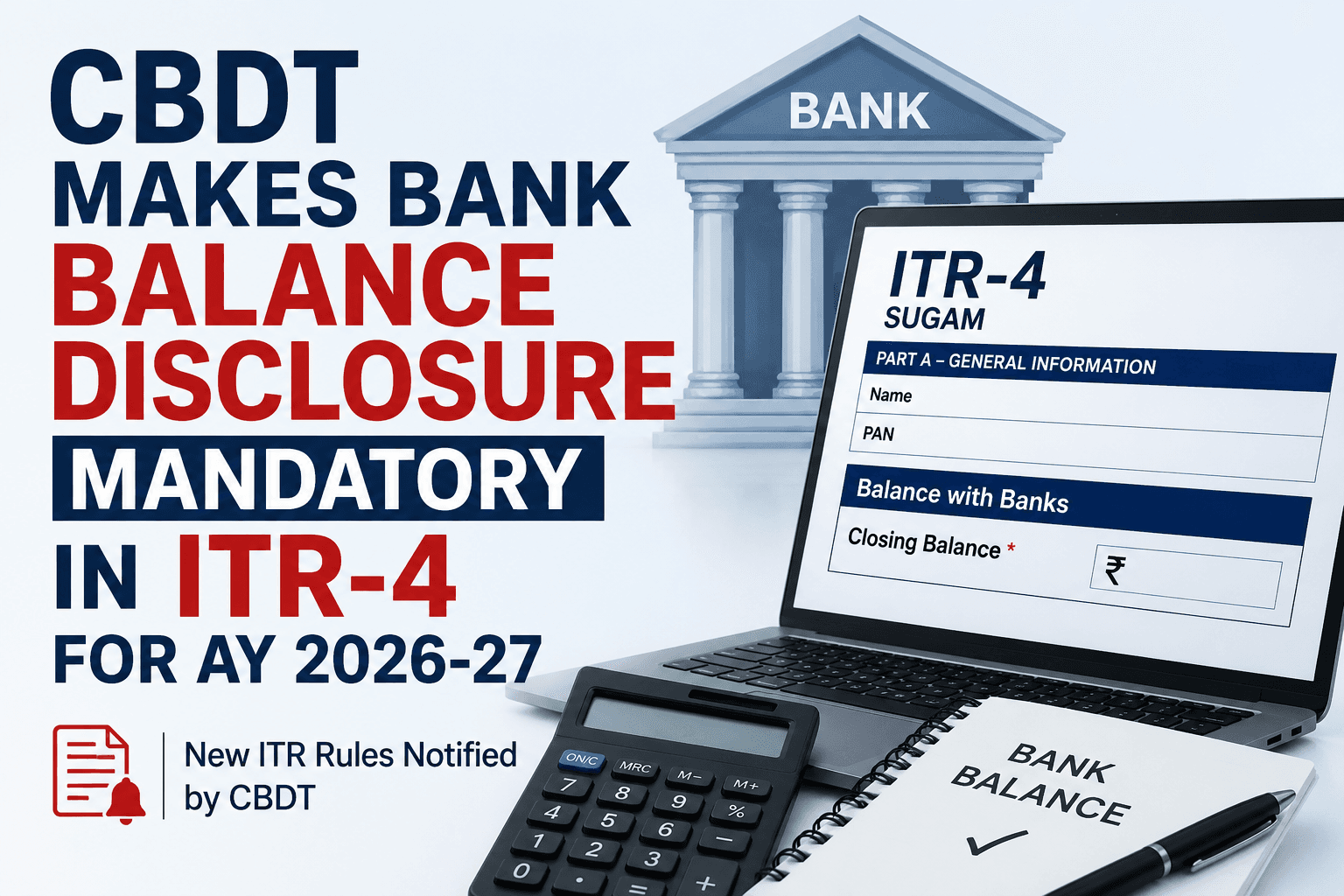
The income tax filing process is set to become more detailed from assessment year (AY) 2026-27. In a significant move aimed at improving financial transparency, the Central Board of Direct Taxes (CBDT) has made it mandatory for taxpayers filing ITR-4 to disclose their bank balances while submitting income tax returns.
The change comes through Notification No. 45/2026 dated March 30, 2026, issued under the Income-tax (Second Amendment) Rules, 2026. The revised return forms introduce additional reporting requirements that could directly impact small business owners, freelancers, professionals, and taxpayers opting for presumptive taxation schemes.
CBDT Introduces New Disclosure Requirement in ITR-4
Under the updated ITR-4 form, taxpayers will now have to provide details related to their “Balance with Banks” at the time of filing returns. Earlier, taxpayers were only required to mention bank account numbers, IFSC codes, and account types mainly for refund verification purposes.
However, the latest update goes a step further by asking taxpayers to disclose balances maintained in bank accounts. This move is expected to give the Income Tax Department better visibility into taxpayers’ financial positions and banking patterns.
The revised reporting requirement specifically applies to taxpayers filing returns through ITR-4 (Sugam), which is commonly used under presumptive taxation provisions.
What is ITR-4 (Sugam)?
ITR-4 is a simplified Income Tax Return form primarily meant for taxpayers opting for presumptive taxation under various sections of the Income Tax Act.
The form is generally applicable to:
- Individuals
- Hindu Undivided Families (HUFs)
- Partnership firms (excluding LLPs)
with income from:
- Business income under Section 44AD
- Professional income under Section 44ADA
- Goods carriage business under Section 44AE
- Salary or pension
- One house property
- Other income such as interest earnings
The form is widely used by small business owners and self-employed professionals due to its simplified compliance structure.
Why Has CBDT Made Bank Balance Reporting Mandatory?
The government has been steadily increasing the use of technology and data analytics in tax administration. By making bank balance disclosure mandatory, authorities are aiming to improve financial transparency and reduce income mismatches.
According to tax experts, the new reporting system may help the department:
- Verify income declarations more effectively
- Identify undisclosed or suspicious transactions
- Improve risk-based scrutiny selection
- Detect cases of tax evasion
- Cross-check financial data with banking records
The move also aligns with the government’s broader push toward digitized financial monitoring and data-driven compliance systems.
What Information Will Taxpayers Need to Provide?
Although the detailed filing utility is yet to be released, taxpayers filing ITR-4 are expected to disclose:
- Bank account details
- Closing balance in bank accounts
- Financial transaction-related information
- Active banking relationships linked to income reporting
Experts advise taxpayers to keep all bank statements and transaction records properly organized before filing returns for AY 2026-27.
Big Impact on Freelancers, Professionals & Small Businesses
The new compliance rule is likely to have a direct impact on:
- Freelancers
- Consultants
- Self-employed professionals
- Traders
- Small business owners
- Presumptive taxation filers
Since ITR-4 is widely used by taxpayers with simplified income calculations, maintaining accurate bank records will now become even more important.
Tax professionals believe that taxpayers should start reconciling bank transactions with declared turnover and income to avoid future notices or discrepancies.
Important Things Taxpayers Should Remember
Before filing ITR-4 for AY 2026-27, taxpayers should ensure:
- Bank statements are updated and verified
- Business receipts match banking transactions
- All active accounts are properly disclosed
- There is no mismatch between declared income and bank balances
- Financial records are maintained systematically
Proper documentation may help taxpayers avoid unnecessary scrutiny and notices from the Income Tax Department.
CBDT Notification Details
The revised income tax return forms were officially notified through the following:
- Notification No. 45/2026
- Date: March 30, 2026
- Issued by: Central Board of Direct Taxes (CBDT)
The amendment was introduced under the Income Tax (Second Amendment) Rules, 2026.
The mandatory disclosure of bank balances in ITR-4 marks another major shift in India’s tax compliance framework. As the Income Tax Department continues to strengthen data-driven monitoring systems, taxpayers using presumptive taxation schemes will need to maintain greater financial accuracy and transparency.
For freelancers, professionals, and small businesses, proper banking documentation and income reconciliation may soon become just as important as filing the return itself.
Need an Instant Personal Loan? Check Eligibility at 10.25%
Compare personalized loan offers from 30+ top banks and NBFCs with zero impact on your credit score.
Check Loan Eligibility OnlineRecommended Reading for You
How to Compare Personal Loan Interest Rates & Fees for Credit Card Debt Consolidation
Learn how to compare personal loan interest rates, processing fees, hidden charges, and repayment terms to find the most cost-effective debt consolidation loan. Expert 2026 guide.
Read ArticleBest Debt Consolidation Loan Hyderabad
Looking for the best debt consolidation loan in Hyderabad? Compare multiple lenders, combine your EMIs into one affordable payment, and apply online with FinCrif today.
Read ArticleITR File Karne Se Pehle Ye 15 Baatein Zaroor Check Karein (2026 ITR updates)
ITR file karne me ek chhoti galti bhi notice ka karan ban sakti hai. Return file karne se pehle ye 15 important baatein zaroor jaan lein.
Read Article