How to Compare Personal Loan Interest Rates& Fees for Credit Card Debt Consolidation
Learn how to compare personal loan interest rates, processing fees, hidden charges, and repayment terms to find the most cost-effective debt consolidation loan. Expert 2026 guide.
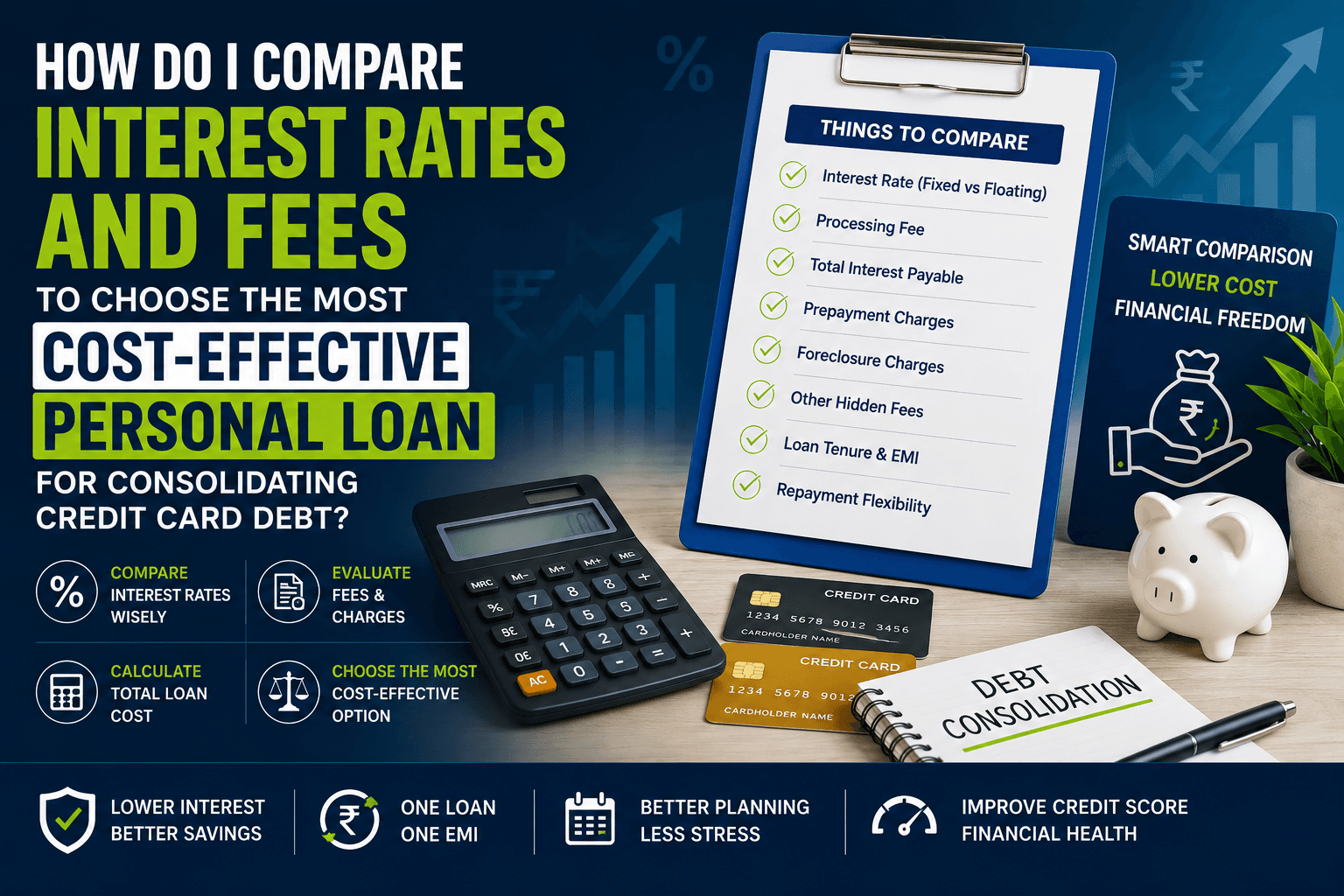
Credit card debt can quickly become overwhelming, especially when you're paying interest rates ranging from 30% to 48% annually. If you have balances spread across multiple cards, managing different payment dates and interest charges becomes stressful.
One of the smartest financial strategies is taking a personal loan for debt consolidation. Instead of paying multiple credit card bills, you replace them with one personal loan that usually offers a lower interest rate and fixed monthly EMI.
However, many borrowers make one major mistake—they only compare the interest rate.
A loan with a lower interest rate isn't always the cheapest option. Processing fees, foreclosure charges, insurance premiums, late payment penalties, GST, and repayment flexibility can significantly impact the total borrowing cost.
This guide explains how to compare personal loan interest rates and fees like a financial expert so you choose the most cost-effective debt consolidation loan.
The most cost-effective personal loan isn't always the one with the lowest interest rate. Compare the APR, processing fee, prepayment charges, foreclosure fee, tenure, EMI, and total repayment amount before making a decision. A slightly higher interest rate with lower fees may save more money overall.
Why Compare More Than Just Interest Rate?
Suppose two lenders offer the following:
| Lender | Interest Rate | Processing Fee |
|---|---|---|
| Bank A | 10.25% | ₹18,000 |
| Bank B | 10.90% | ₹2,000 |
At first glance, Bank A looks cheaper.
But after adding the processing fee, Bank B may actually cost less over the loan tenure.
The total borrowing cost always matters more than the advertised interest rate.
Step 1: Compare the Annual Interest Rate
Interest rate is still the biggest factor.
For debt consolidation loans, borrowers generally receive rates based on:
- Credit Score
- Income
- Employment Type
- Existing Debt
- Employer Profile
- Loan Amount
- Loan Tenure
Generally:
- Excellent Credit (750+) → Lower rates
- Good Credit (700-749) → Competitive rates
- Fair Credit (650-699) → Moderate rates
- Poor Credit (<650) → Higher rates
Even a 1% lower interest rate can save thousands over the loan tenure.
Step 2: Check Fixed vs Floating Interest Rate
Personal loans generally come with:
Fixed Interest Rate
- EMI remains constant
- Easy budgeting
- No surprise increases
Floating Interest Rate
- Changes with market conditions
- EMI may increase or decrease
- Higher uncertainty
For debt consolidation, a fixed-rate loan is usually the better choice because predictable payments help improve financial discipline.
Step 3: Compare Processing Fees
Most lenders charge a one-time processing fee.
Typical range:
- 0.5%
- 1%
- 2%
- Up to 3%
Example:
Loan Amount: ₹8,00,000
Processing Fee:
- 0.5% = ₹4,000
- 2% = ₹16,000
Difference:
₹12,000
Always include this fee when calculating your loan cost.
Step 4: Calculate the Total Interest Payable
Instead of focusing only on EMI, calculate:
- Total EMI Paid
- Minus Principal
- Equals Total Interest
Example:
Loan:
₹7,00,000
Interest:
11%
Tenure:
5 Years
Total EMI Paid:
₹9.12 Lakhs
Interest Paid:
₹2.12 Lakhs
Now compare another lender.
Sometimes a slightly lower EMI actually results in paying more interest because the tenure is longer.
Step 5: Look for Hidden Charges
Many borrowers ignore additional costs.
Common charges include:
- Documentation Fee
- Loan Insurance
- Stamp Duty
- Legal Charges
- Verification Charges
- GST
- Late Payment Penalty
Always ask for a complete fee schedule before accepting any loan.
Step 6: Compare Foreclosure Charges
What if your financial situation improves and you want to repay the loan early?
Some lenders charge:
- 2%
- 3%
- 5%
on the outstanding amount.
If you expect bonuses, business income, or salary hikes, choose lenders with low or zero foreclosure charges.
Step 7: Compare Part-Payment Facility
A good debt consolidation loan should allow:
- Extra EMI
- Lump sum payment
- Partial prepayment
Without heavy penalties.
Reducing the principal early saves a significant amount of interest.
Step 8: Evaluate Loan Tenure Carefully
A longer tenure means:
✔ Lower EMI
But also:
❌ Higher total interest
Example:
₹5 Lakhs Loan
3 Years
EMI:
₹16,400
Total Interest:
₹90,000
5 Years
EMI:
₹10,900
Total Interest:
₹1.55 Lakhs
Choose the shortest tenure that comfortably fits your monthly budget.
Step 9: Compare EMI Affordability
Your EMI should ideally remain within 30–40% of your monthly disposable income.
For example:
Monthly Income:
₹80,000
Maximum Comfortable EMI:
₹24,000–₹32,000
This helps maintain financial stability while repaying the loan.
Step 10: Check Credit Score Requirements
Better credit scores unlock:
- Lower interest rates
- Higher loan amounts
- Faster approvals
- Better lender offers
Improving your credit score before applying can lead to meaningful savings over the loan's life.
Step 11: Compare Loan Approval Speed
If you're paying high-interest credit card debt, timing matters.
Many digital lenders offer:
- Instant eligibility checks
- Quick document verification
- Same-day approval (subject to verification)
- Fast disbursal
The sooner the credit card debt is repaid, the sooner high-interest charges stop accumulating.
Step 12: Look Beyond EMI
Never compare loans only by EMI.
Instead compare:
- Interest Rate
- Processing Fee
- Total Interest
- Total Repayment
- Prepayment Charges
- Foreclosure Charges
- Late Payment Fees
- Hidden Charges
- Customer Service
- Repayment Flexibility
This gives a much clearer picture of the true cost.
Example Comparison
Suppose you want to consolidate ₹10 Lakhs of credit card debt.
| Feature | Loan A | Loan B |
|---|---|---|
| Interest Rate | 10.75% | 11.25% |
| Processing Fee | ₹25,000 | ₹5,000 |
| Prepayment Charge | 4% | Nil |
| Foreclosure | 3% | Nil |
| Total Interest | ₹2.80 Lakhs | ₹2.95 Lakhs |
| Overall Cost | Higher | Lower |
Although Loan A offers a lower interest rate, Loan B could be more economical after accounting for fees and repayment flexibility.
Compare the Debt Consolidation loan quickly!
Questions to Ask Before Choosing a Debt Consolidation Loan
Before signing the agreement, ask:
- Is the interest rate fixed or floating?
- What is the processing fee?
- Are there any hidden charges?
- Can I prepay without penalties?
- Is foreclosure allowed?
- What happens if I miss an EMI?
- Is insurance compulsory?
- Can I change my EMI date?
- What is the total repayment amount?
Common Mistakes to Avoid
Avoid these costly errors:
- Choosing the lowest advertised interest rate without checking fees.
- Extending the tenure only to reduce EMI.
- Ignoring processing charges and taxes.
- Not reviewing prepayment and foreclosure conditions.
- Borrowing more than necessary for consolidation.
- Missing EMIs after consolidating your debt.
A disciplined repayment plan is essential to maximize the benefits of debt consolidation.
Benefits of Choosing the Right Debt Consolidation Loan
When you compare loans carefully, you can enjoy:
- Lower overall borrowing costs
- Reduced monthly EMI burden
- One simple monthly payment
- Improved budgeting
- Faster debt repayment
- Better credit score with timely payments
- Less financial stress
- Greater flexibility to prepay and save on interest
A personal loan can be an effective way to consolidate high-interest credit card debt—but only if you evaluate the total cost of borrowing, not just the advertised interest rate.
Review processing fees, prepayment rules, foreclosure charges, repayment tenure, and all associated costs before making your decision. A loan with a slightly higher interest rate but lower fees and flexible repayment options may prove to be the more affordable choice in the long run.
Taking time to compare lenders thoroughly can save you thousands of rupees, simplify your finances, and help you become debt-free sooner.
Frequently Asked Questions (FAQs)
1. Is a personal loan cheaper than paying credit card debt?
In many cases, yes. Personal loans often have lower interest rates than revolving credit card balances, making them a cost-effective option for debt consolidation.
2. Which fee is most important besides the interest rate?
Processing fees, prepayment charges, foreclosure fees, and late payment penalties can all materially affect the total cost of the loan.
3. Should I choose the lowest EMI?
Not necessarily. A lower EMI usually comes from a longer tenure, which often means paying more interest overall.
4. Can debt consolidation improve my credit score?
Yes. Consistently paying a single consolidated loan on time can improve your payment history and reduce credit utilization, both of which can positively influence your credit score.
5. What credit score is ideal for the best personal loan rates?
A credit score of 750 or above generally provides access to the most competitive personal loan interest rates and better approval chances.
Need an Instant Personal Loan? Check Eligibility at 10.25%
Compare personalized loan offers from 30+ top banks and NBFCs with zero impact on your credit score.
Check Loan Eligibility OnlineRecommended Reading for You
Best Debt Consolidation Loan Hyderabad
Looking for the best debt consolidation loan in Hyderabad? Compare multiple lenders, combine your EMIs into one affordable payment, and apply online with FinCrif today.
Read ArticleITR File Karne Se Pehle Ye 15 Baatein Zaroor Check Karein (2026 ITR updates)
ITR file karne me ek chhoti galti bhi notice ka karan ban sakti hai. Return file karne se pehle ye 15 important baatein zaroor jaan lein.
Read ArticleBusiness Loan vs Bank Overdraft: Which Financing Option Is Better for Self-Employed Professionals?
Compare Business Loans and Bank Overdrafts to find the right financing option for your business. Learn the key differences, benefits, costs, and ideal use cases for self-employed professionals and entrepreneurs.
Read Article